

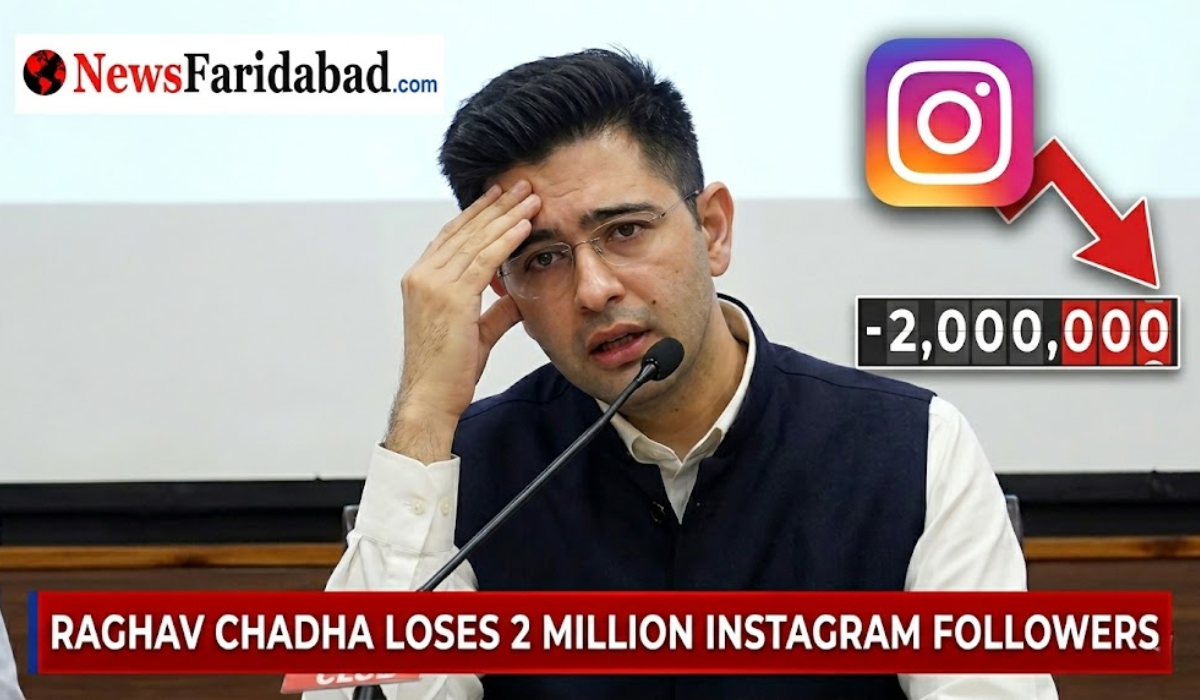
In another important update from India’s political and social media hotbed, Rajya Sabha MP Raghav Chadha loses 2 million Instagram Followers in no time. The crash has since spread across the web, with adventures ranging from political retribution to battling for digital presence.
Chadha saw her follower count plummet from over 14.6 million to about 12.2 million, marking one of the worst social media losses for a contemporary Indian politician in recent months, according to reports.
This drastic shift has led some analysts to wonder what initiated such a rapid unfollow exodus, and if it indicates some larger political frustration or carefully coordinated social media activity.
Who is Raghav Chadha?
Raghav Chadha (born 11 December 1988) is an Indian politician and Member of Parliament from the Rajya Sabha who came to prominence through the Aam Aadmi Party (AAP). Raghav Chadha had a big following among the urban youth and Gen Z audiences due to his effective communication skills and strong digital presence.
Even his social media presence was considered a natural extension of his political appeal, as Raghav Chadha is one of the most visible faces in Indian politics.
Read More: Raghav Chadha: Net Worth, Wife, Party, Suspension & More
What Happened: The Sudden Drop in Followers
The report mentioned that less than twenty-four to forty-eight hours later, Raghav Chadha account on Instagram( raghavchadha88 ) saw a significant drop of about 2 million followers.
As per a report on the drop, this was due to several developments in politics that happened, such as his departure from AAP by being out of the picture, along with his words and activity on social media.
His account peaked at 14.6 million followers, then fell to somewhere between around 12.2 and 13.1 million in reporting that followed relatively quickly thereafter.
Key Reasons Behind the Loss of Followers
1. Political Party Switch Backlash
Raghav Chadha is the only candidate cited by name, which some say may be a sign he has moved from AAP to BJP.
Political switching, in particular, has incendiary online effects that are reinforced the most by those with a strong party identity tied to ideology. Due to this, not many users had opted out of becoming test subjects.
His decision also sparked a backlash among younger voters who had once praised him and led to an immediate social media storm, with one report claiming Raghav Chadha lost his “cool” factor.
2. Gen Z Disappointment and Digital Protest
His image among Gen Z users as an assertive “youth leader” was a prominent reason behind this.
But then, after he changed his politics, this vast chunk of the audience apparently stopped engaging with him. Analysts have been calling this a “Gen Z unfollow campaign,” and from what BuzzFeed wrote on this, the act of collectively unfollowing Williams was treated as a form of symbolic rejection.
This mirrors a larger trend of social media users using the platform unfollowing as an act of political dissent.
3. Perception of Political Opportunism
One other major reason that is cited online is the perception that what he did was politically motivated for his further career.
Many critics on social media have said the type of position-switching undermines trust in government, particularly when a leader is seen to change course for political gain or personal advantage. This perception did damage and led to panic unfollowing.
4. Viral Social Media Effect
Collective behavior is typically amplified on social media. Unfollow may start trending and lead to more of its own, by:
- Viral posts and hashtags
- Influencer reactions
- Group participation behavior
- Algorithm-driven visibility of criticism
As a result, even neutral users get into the mix, and it starts snowballing.
5. Changing Digital Image and Public Perception
Chadha was a modern, progressive, youth-focused politician in the past.
Nevertheless, political context and controversies paved the way for how audiences see him online. Users started to disengage, as they no longer identified with his new positioning.
Political and Social Media Impact
The dwindling of followers is not only a functional metric of the digital space it mirrors larger political and social forces:
- Image damage in youth demographics
- Loss of symbolic online popularity
- Increased scrutiny of political messaging
- Showcasing the volatility of social media impact
Experts say that the following numbers are unlikely to factor directly into electoral impact, but do help shape public perception along with media narratives.
Supporters’ Perspective
Reactions to this have not all been negative. Supporters argue:
- Having lots of social media followers does not mean you have real voters
- The decisions of lives for political decisions should not be based on the online trends after all
- Some of the unfollows are inactive or bot accounts
- Over time, leaders who engage with followers do so more successfully.
Some argue that such declines are temporary and the result of short-term, emotional responses, not long-term changes in what people want from politics.
Opposition View and Criticism
The incident, however, has been viewed by critics as:
- A reflection of declining trust
- Signs of disconnection with youth supporters
- A consequence of political inconsistency
- A first amber warning for personal branding in politics
The argument here also shows that political identity and digital identity are merging the more we go.
Conclusion
The near loss of 20 lakh followers on Instagram by Raghav Chadha is a testament to the fickle nature of citizens in this digital age.
The most likely rationale would seem to be a combination of:
- Political party switch backlash
- Youth-driven online protest behavior
- Perception of opportunistic politics
- Viral amplification on social media
The long-term political implications of this episode, either for India or smaller societies in similar turmoil, are not immediately clear, but it is very evident that we have moved into a fragmented age when the fragility of social media popularity has been exposed: such popularity is fickle, fast-moving, and reacts very quickly to political activity.
It remains to be seen whether this slide is temporary or permanent, since it will ultimately be up to Raghav Chadha how he manages his reputation and what relationship he can continue with voters going forward.