

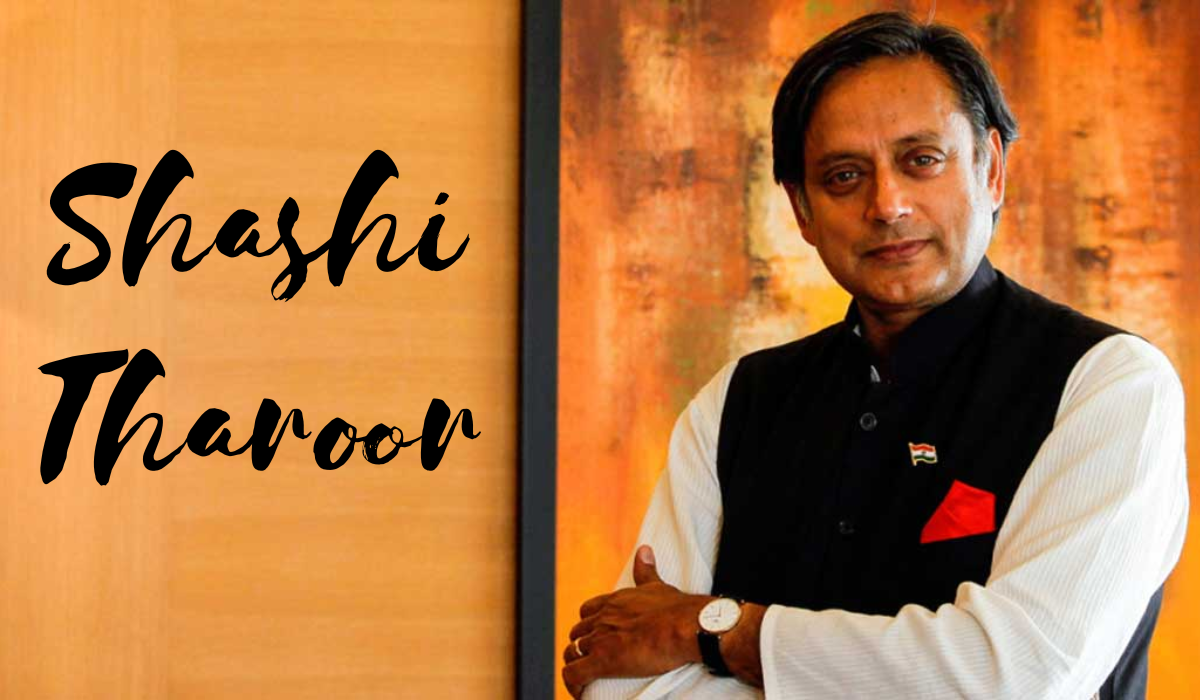
Shashi Tharoor is among the most recognisable and intellectually formidable faces in Indian public life, a man who wears multiple hats with dimensions of ease that are little short of amazing. He is currently a three-term Member of Parliament representing Thiruvananthapuram in Kerala; an award-winning author of more than twenty-five books; a former senior official of the United Nations; and perhaps the most capable and well-known English speaker, down to everyday discourse, in Indian public life today. Be it his roaring speeches in Parliament, his viral tweets on X (formerly Twitter) or his incandescent anti-colonial rhetoric, Tharoor has created a niche for himself in India’s political and cultural landscape.
Tharoor was born on 9 March 1956 in London in a family hailing from a Keralite background, and he grew up traversing cultures and continents, a journey that would ultimately shape his global outlook and the cosmopolitan identity he now fiercely espouses. Tharoor’s story from a young student in India to doctoral researcher in the United States and then a long diplomatic career in New York and Geneva is one of singular intellectual ambition and service to his country. Today, he is one of the most followed politicians on social media and among India’s most in-demand public speakers, as well as a thinker whose books continue to inform national conversations about colonialism and democracy, Hindu identity.
Quick Information Table
| Category | Details |
| Full Name | Shashi Tharoor |
| Date of Birth | 9 March 1956 |
| Place of Birth | London, United Kingdom |
| Nationality | Indian |
| Education | St. Stephen’s College, Delhi; Tufts University, USA (PhD) |
| UPSC Rank | Not a civil servant joined the UN directly after a PhD |
| Political Party | Indian National Congress (INC) |
| Constituency | Thiruvananthapuram, Kerala |
| Wife | First: Tilottama Mukherji; Second: Christa Giles; Third: Sunanda Pushkar (d. 2014) |
| Books Written | 25+ books, including ‘An Era of Darkness’, ‘Inglorious Empire’ |
| UN Career | Served 29 years; Under-Secretary-General |
| Twitter/X Handle | @ShashiTharoor |
| Known For | Eloquent English oratory, wit, prolific writing, and anti-colonial scholarship |
Read Also: Priyanka Gandhi Vadra: Biography, Political Career, Family & Latest News
Shashi Tharoor’s Early Life and Education
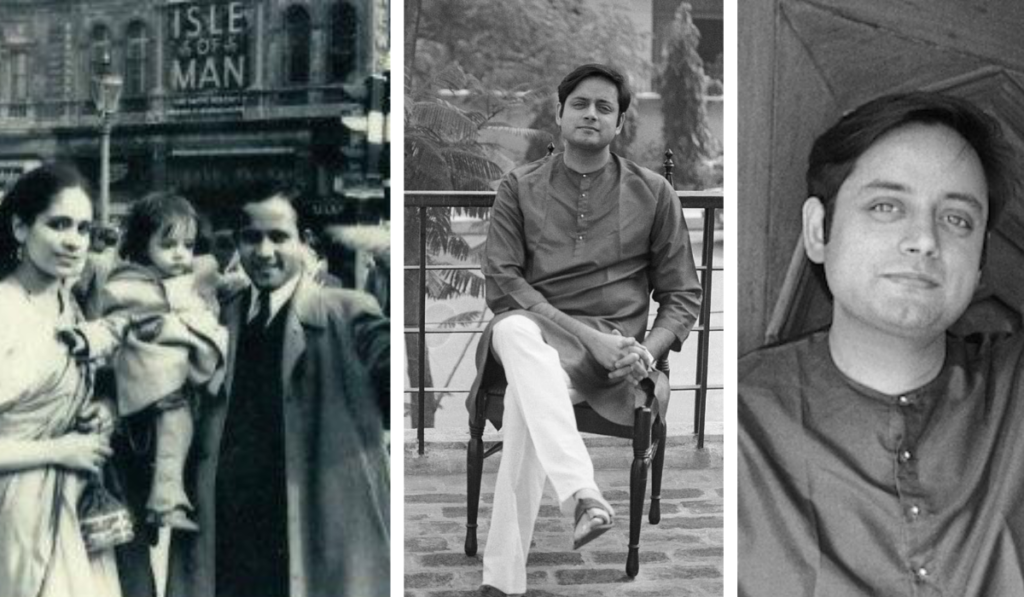
Shashi Tharoor was born in London, the son of journalist Chandran Tharoor and Lily Tharoor. His family was from the Palakkad district of Kerala. He lived in Mumbai until he was 4, and then moved to Kolkata, eventually taking up the intellectual rhythms of Delhi. These diverse geographies are where young Tharoor’s love of language, history and public affairs began.
Tharoor attended Campion School, Mumbai and then The Lawrence School, Lovedale, Nilgiri Hills. His academic brilliance emerged early; he was an enthusiastic debater, a voracious reader and a young writer of remarkable promise. He studied History at St. Stephen’s College, Delhi University, one of the most prestigious institutions in India. Was it among Delhi’s intellectual elite that the young Shashi Tharoor, a sharp, articulate and deeply curious creature, really discovered his voice?
Following his undergraduate work, Tharoor earned a distinction and went on to graduate studies at Tufts University in the US at the Fletcher School of Law and Diplomacy, earning his Master’s degree, and later his PhD. His doctorate was an exercise in peace-keeping operations and international law, a subject he would later practise at the highest levels of the United Nations. So it was that his education was not just an academic one but a powerful, transformative experience, shaping the internationalist and humanist vision that would mark every phase of his later career.
Shashi Tharoor and the UPSC: Clearing the Air
One popular piece of misinformation that gets a lot of circulation, especially on search engines, where ‘Shashi Tharoor UPSC rank’ is a frequently searched query, is that Shashi Tharoor was someone who cleared the civil services/ UPSC examination. This is not accurate. Shashi Tharoor never sat for the UPSC Civil Services Examination. He also did not join the IAS, IFS or any other UPSC-administered cadre.
Tharoor did not sign away his soul at all; he went to work directly for the United Nations High Commissioner for Refugees (UNHCR) in 1978 after earning his PhD from Tufts University and before long started a nearly three-decade-long career. He began to climb the UN hierarchy rapidly and deservedly propelled by intellectual brilliance and diplomatic skill rather than bureaucratic study. He eventually became Under-Secretary-General for Communications and Public Information at the United Nations, one of the highest-ranking posts in the global body.
The misunderstanding about his UPSC rank seems to arise from being a member of India’s governance class, as well as through his educational pedigree, and possibly even an assumption that any high-achieving Indian official must have passed through the portal of the civil services examination. In Tharoor’s case, though, the path was uniquely his own, international, scholarly and shaped by global institutions instead of domestic tests.
A Stellar Career at the United Nations
Tharoor’s career at the United Nations took place over an extraordinary twenty-nine years, from 1978 to 2007. He held multiple roles in the organisation, taking on some of its most challenging humanitarian and peacekeeping crises of the late twentieth century. His assignments included stints in Geneva, New York and Singapore, providing him with a unique perspective on geopolitics around the globe.
His most notable assignments included his position as the Special Assistant to the UN Secretary-General during one of the most crucial periods in the Cambodian peace process. He had also been chief of peacekeeping operations in the former Yugoslavia during the Balkans conflict, one of the most complicated and emotionally searing assignments in United Nations history. His years in those posts provided not only diplomatic skills but a deep understanding of human misery, institutional betrayal and the limits to international law.
In 2006, Tharoor made a historic and high-profile run for UN secretary-general he eventually lost to South Korean Ban Ki-moon after a competitive process. His candidacy, advocated by India, gave him an international profile and set him apart as a statesman of global standing. The next year, in 2007, he left the UN and returned to India, igniting what would become his political career.
Shashi Tharoor’s Political Career
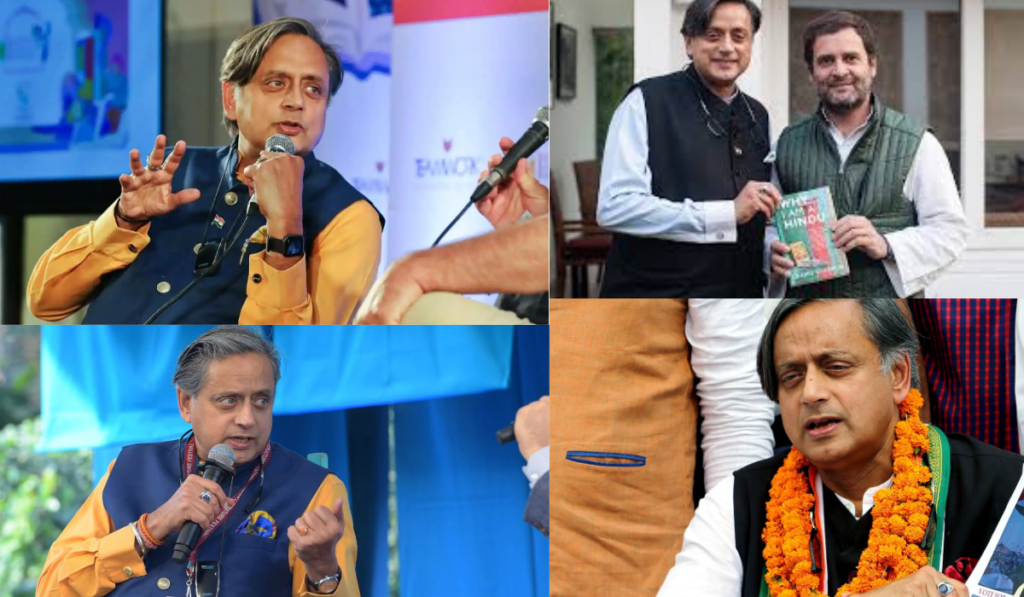
Shashi Tharoor began his political career in India in 2009 when he ran for and won the Lok Sabha seat from Thiruvananthapuram, Kerala, on a Congress ticket. His entry into politics was not without its controversy; critics maintained he was better suited to international platforms than the rough-and-tumble of Indian electoral democracy. He confounded sceptics to win his constituency in 2009, 2014 and also in 2019, establishing a loyal support base through a mixture of local development work, international credibility and his unique brand of intellectual engagement with constituents.
He had a brief stint as Minister of State for External Affairs from 2009 to 2010 under Prime Minister Manmohan Singh, which was abbreviated after controversy over his use of the expression “cattle class” in a tweet, an expression he meant ironically but one that drew outsized media and political backlash. It was an early lesson in the idiosyncratic sensitivities of Indian political culture. Tharoor’s political star, however, remained on the rise; he was Minister of State for Human Resource Development from 2012 to 2014.
Perhaps his most formative act in Parliament, and indeed, modern Indian political speech (there never had a BN Raj to less than a watering) was when he spoke at the Oxford Union in 2015, arguing that Britain should pay reparations for two centuries of colonial looting. The speech, which went viral worldwide, vaulted Tharoor into a whole new realm of public intellectual and anti-colonial thinker. It was a moment that showcased his scholarship, his oratorical gifts and his political instincts in ways that few Indian politicians since Jawaharlal Nehru have managed.
Read Also: Narendra Modi: India’s Prime Minister, Age, Education, Salary, Net Worth, Religion & Wife
Shashi Tharoor’s English: The Art of the Spoken Word
Few aspects of Tharoor’s public persona inspire as much fascination and Googling as his command of the English language. Shashi Tharoor’s English is legendary. He is also known for using words that come to most educated people’s mouths and minds only when they consult their dictionaries: ’floccinaucinihilipilification’, ‘rodomontade’,‘loquacious’, ‘farrago’ troglodyte words that drive audiences and readers scuttling away to their dictionaries, and have made him something of a cult figure among those who speak Indian English and students.
This is not low-level linguistic performance. Tharoor’s fluency in English is the product of decades spent reading, writing and thinking seriously in that language. His speeches at Oxford, the Indian Parliament and literary festivals alike are meticulously constructed and densely reasoned, yet delivered with the rhythmic inflexions and self-assuredness that make him one of the most compelling orators in the English-speaking world today. His Shashi Tharoor speech at the Oxford Union regarding British colonial reparations is already seen as a landmark of modern political oratory.
He always mingles historical depth with rhetorical precision in his speeches. He doesn’t just make an argument, he builds. Each of her speeches is a layered edifice of evidence, analogy and wit, delivered with an ease that conceals the extensive preparation that goes into it. Tharoor remains the master class in persuading, whether a student of public speaking, debating or English prose.
The literary output of Shashi Tharoor is remarkable in both volume and scope. He is the author of more than twenty-five books, including fiction, political commentary, history, biography and cultural criticism. His works have been translated into several languages and have sold millions of copies worldwide.
Fiction
Tharoor’s fiction stands out for its wryness, for its political sparring and for how deeply engaged it is with India’s post-independence identity. His first novel, The Great Indian Novel (1989), is a brilliant retelling of the Mahabharata that plays out in the context of 20th-century Indian politics, a work that declared him as an author of extraordinary ambition. Then came Show Business (1992), a satire of Bollywood, and Riot (2001), a polyphonic novel about communal violence in India.
Non-Fiction and Historical Works
Tharoor has perhaps made his most lasting contribution in non-fiction. “An Era of Darkness: The British Empire in India” (2016), published overseas as “Inglorious Empire” to echo the nickname for the Oxford Union address, developed directly from that viral speech and became one of the most widely read and debated books about colonialism in recent years. Based on exhaustive research, Tharoor methodically dismantles the myth of benevolent British rule as he documents the economic devastation, cultural suppression and institutional destruction inflicted by two centuries of imperial exploitation.
Other notable non-fiction books include India: From Midnight to the Millennium (1997), a broad consideration of India at fifty; The Elephant, the Tiger, and the Cell Phone (2007), an inquiry into modern Indian identity; Pax Indica (2012), on India’s foreign policy; and Why I Am a Hindu (2018), an examination of some of Hinduism’s philosophical and pluralist traditions a cause for great public controversy in Tharoor’s case, suggesting his readiness to address even the most fraught questions animating Indian public life.
Shashi Tharoor’s Wife and Personal Life
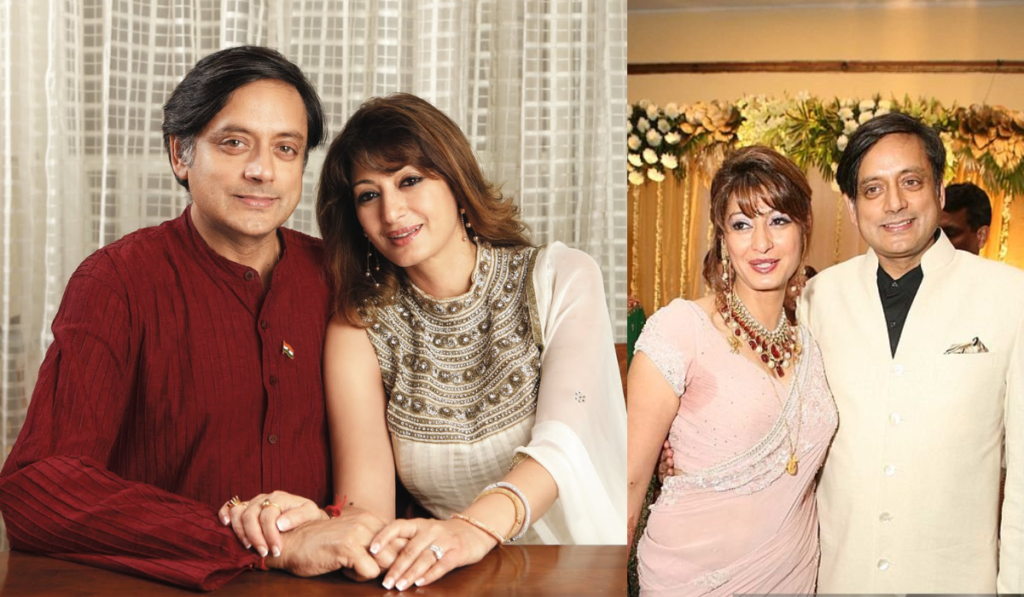
Shashi Tharoor’s private life has been as much before the public as his professional one. He has had three marriages. His first wife, whom he married in 1975, was Tilottama Mukherji. They later separated. His second wife, a Canadian citizen, was Christa Giles, with whom he had twin sons, Ishaan and Kanishk. This marriage also ended in separation.
His third (and most public-facing) marriage was to businesswoman and Kashmiri-born entrepreneur Sunanda Pushkar. Their relationship received a lot of media attention both in its courtship and, tragically, its denouement. On the night of 17 January 2014, Sunanda Pushkar died in a Delhi hotel under disputed and controversial conditions. Her death sparked a drawn-out legal and media maelstrom, which hung over Tharoor’s political career for many years. A Delhi court eventually dropped him from the case in 2021.
Despite the very personal tragedies and controversies that have swirled around his private life, Tharoor has remained engaged on public platforms, often speaking freely about loss, grief and resilience qualities he needed in great measure and which many citizens have come to sympathise with or respect him for being able to display and exercise.
Shashi Tharoor Young: From Prodigy to Statesman
Those going for Shashi Tharoor Young will see a man who was an early bloomer and showed unerring promise. Even at Cambridge, and later Tufts, the young Tharoor was writing with the fluency and confidence of a seasoned author. He was still in his thirties when writing his first novel, and during the early part of his UN career, he was charged with responsibilities far beyond his years.
The photographs of Tharoor from his twenties and thirties show a lean, sharp-featured young man, one who already seemed to have decided that he was going to be taken seriously. That youthful idealism, which was rooted in a Nehruvian faith in democracy, multilateralism, and humanist values, has not entirely gone, even as young decades of political battle have added a layer of pragmatism and resilience. His young admirers now, many of them aspirants for competitive examinations or preparing for debating competitions, are those young versions of Tharoor. Their wariness and disciplined reading and writing are inflected with an air of intellectual ambition, pointing towards ShashiTharoor as an example of what they can hope to achieve.
Shashi Tharoor on Twitter/X: The Social Media Intellectual
The Social Media Intellectual Shashi Tharoor’s implications on Twitter, now on X, are among the most followed and debated Twitter debuts by any Indian politician. He uses the @ShashiTharoor handle, which has millions of followers. His tweets range from political commentary to literary allusions, to wordplay, puns, and the occasional use of genuinely obscure English terms, requiring followers to sprint to Google. The implications of social media are distinctively intellectual.
While many politicians exploit Twitter as a tool to communicate partisan messages to their followers, Tharoor uses his Twitter account as a public salon. This is a space to present and debate ideas, to joke around frequently, recommend books, and express measured political viewpoints. The Sunday wordplay posts have become followers’ favourite weekly ritual. Shashi Tharoor’s Twitter implications have led him into controversies a few times, such as the cattle-class content. However, on balance, his social media implications have been a valuable avenue for building a sub-party political brand.
Read Also: Delhi Businessman Killed Over Financial Dispute, Body Dumped in Faridabad; 2 Held
Frequently Asked Questions (FAQs)
Q: UPSC rank of Shashi Tharoor?
Never appeared for the UPSC Civil Services Examination. He is not a civil servant. He joined the United Nations directly in 1978 and spent his entire career with that international organisation, eventually attaining the rank of Under-Secretary-General after earning his PhD from Tufts University {Fletcher School of Law and Diplomacy}.
Q: How many books has Shashi Tharoor written?
Shashi Tharoor wrote more than 25 books, of fiction as well as history, political commentary and cultural analysis. His best-known works include The Great Indian Novel (1989), An Era of Darkness / Inglorious Empire (2016), Why I Am a Hindu (2018) and India: From Midnight to the Millennium (1997).
Q: Who is the wife of Shashi Tharoor?
Tharoor has had three marriages. His first wife was Tilottama Mukherji, and his second was Christa Giles (with whom he has twin sons, Ishaan and Kanishk). Sunanda Pushkar, his third wife, died under disputed circumstances in January 2014. Tharoor was acquitted in the related legal case in 2021.
Q: Where did Shashi Tharoor study?
Tharoor did History at St. Stephen’s College, Delhi University. This was followed by his move to the United States, where he did his Master’s degree and PhD from Fletcher School of Law and Diplomacy at Tufts University with a concentration in international law and peacekeeping.
Q: What’s the deal with Shashi Tharoor’s English?
Tharoor is famous for his erudite vocabulary and polished delivery. He has often relied on rare or arcane English words in speeches, tweets and interviews, earning him something of a cult following among language enthusiasts. His mastery of English is the product of decades spent reading seriously, being schooled and communicating professionally in international environments.
Q: Tharoor’s most famous speech is the one he gave arguing for India to retain ownership of its jewel.
His speech at the Oxford Union in 2015, where he argued Britain owed reparations to India for two centuries of colonial rule, is widely cited as his most famous and influential speech. The video went global, hit millions, and directly resulted in his book An Era of Darkness / Inglorious Empire.
Q: What is the social media handle of Shashi Tharoor?
Shashi Tharoor is on X (formerly Twitter) at @ShashiTharoor. He has millions of followers, and is best known for posts with clever wordplay, political barbs and literary allusions. This is the account of one of the most followed Indian politicians on the platform.
Q: What is Shashi Tharoor’s political party?
Shashi Tharoor is part of the Indian National Congress (INC). Since then, he has contested a seat in the Lok Sabha from Thiruvananthapuram and since 2019 has won three consecutive general elections for the same seat in 2009, 2014 and 2019.
Conclusion: A Unique Voice in Indian Public Life
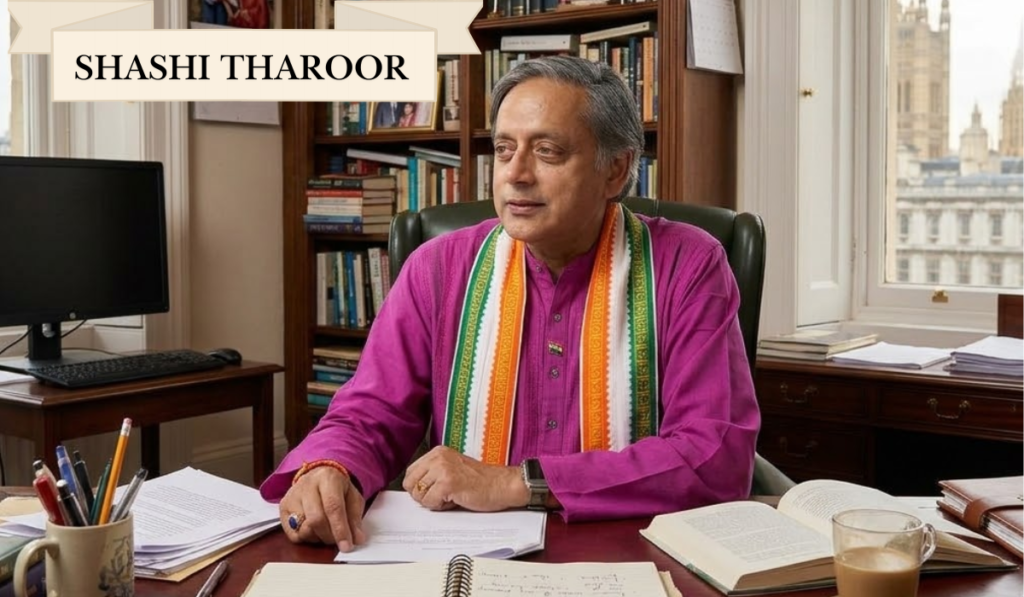
Shashi Tharoor defies easy categorisation. He is a politician with the writing style of a novelist, a diplomat who tweets like a wit, a scholar who argues like a barrister and an Indian more comfortable in Geneva or New York than Thiruvananthapuram. His life and career embody one kind of Indian excellence, cosmopolitan in sensibility, values-driven, and deeply proud of civilisational inheritance while being critical of institutional failure.
Agree with his politics or not, Tharoor’s addition to Indian public conversation is ineluctable. He has brought a level of intellectual seriousness, historical depth and rhetorical elegance to political conversation that is rarely found in any democracy. His books have transformed the way Indians and the world think about colonialism. His speeches have inspired a generation of young Indians to take language, history and public service seriously. And his presence in Parliament, interrogating, arguing, proposing, is the best aspiration of what democratic representation can look like.
As India passes through a complicated and contentious phase of its democratic history, voices like Tharoor’s, educated, articulate, nonchalant of authority or orthodoxy and committed to pluralism are not just useful; they are necessary. Whatever awaits him in his next chapter, Shashi Tharoor’s place in the tale of modern India is a secure one.
Read Also: Teen Stabbed to Death in Gurugram Over ₹3,000 Loan Dispute